NEBULASYNTH
SYNTH · 14-DAY TRIAL

NEBULA

Built for haunting, future-machine sounds and for playing live. Every preset is levelled so browsing never jumps in volume, and the first eight knobs on Push are Cutoff, Resonance, the two Morphs, Attack, Release, Macro 1 and Preset.

Try it freeBuy, £79 £49
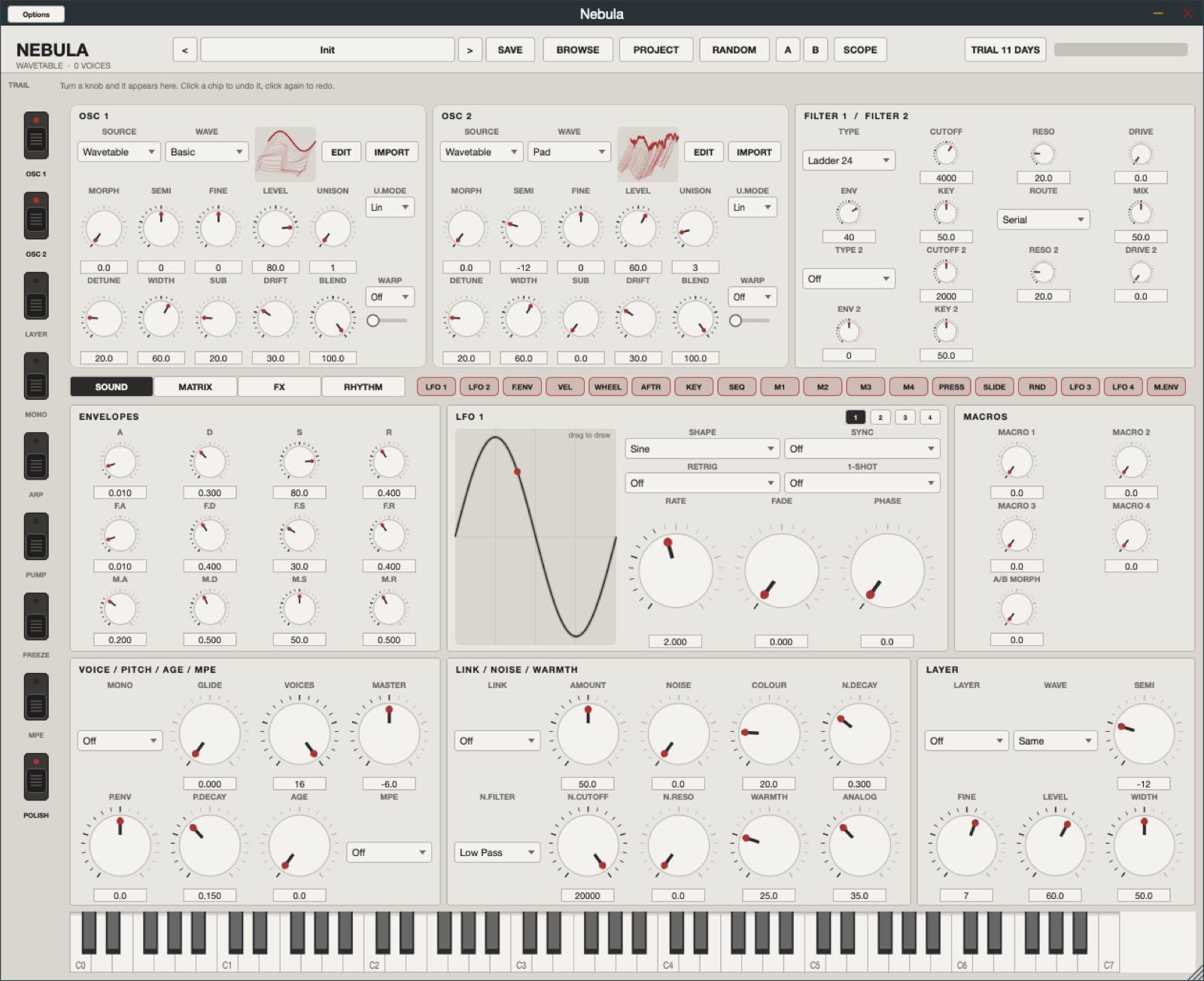
Nebula window

What is inside

The short version. The full guide comes with the download.

Seven oscillator engines

16-voice unison with five spread modes and blend. Wavetable (16 frames, 24 band-limited copies, Hermite reads), Sample, Grain, FM operator, Modal (struck steel, bell, glass, membrane), Fold and Phase Distortion. Up to 7-voice unison with drift, plus a sub.

Samples, multisamples, time stretch, vinyl

Load one file or a whole folder with one sample per note. Stretch time without moving the pitch, freeze on one spot, play the grains, or put the file on a turntable and scratch it with the mod wheel. A spectrogram shows the file with the play head moving through it.

Audio in: vocoder, ring modulator, pitch follow

Send a voice, a guitar or any track into Nebula as a side chain. The vocoder makes the synth sing your words in 8, 16 or 32 bands with formant shift. The ring modulator multiplies the input by the synth, a sine or noise. Pitch follow plays the synth at the pitch you sing. Or send the input straight through the effects, tape and radio.

Mixer

A MIX page with a strip per source: fader, pan, bus switch, mute, solo and meter. Send any source to effect bus A, B or both. Bus and main meters, a master fader and a mono check.

Path LFO

Draw a letter, a loop or a cave and the LFO travels along the line, backwards and over itself if that is how you drew it. The pen's height is one output and its sideways position another, so one stroke moves two things. Play it evenly or with the timing you drew it at.

Choir voices

A Choir wave that opens from a closed-mouth hum through oo and oh to a full ah with the singer's formant, built to haunt: slow movement, breath, a small detune between the singers and a long hall. Whispers, screams, moans, wails, breath and a ghostly throat in the grain library. Ten presets in the Choir bank.

Grain library

Grain, Sample and Vinyl modes come with eighteen built-in sounds the synth makes itself: choirs, whispers, screams, a bowed string, a glass bell, a breath flute, a felt piano, a low drone, a vowel sweep, a metal hit, rain, wind and a vinyl bed. Pick one from LOAD and play. A Grains bank of presets shows what they can do.

Tape, valve and radio

A cassette deck with oxide on the heads, wow and flutter, hiss and a valve stage that blooms under load. A 70s radio on LW, MW or FM: tune off the station for the whistle, the static and the fade. A Mono / Stereo / Wide / Super Wide speaker switch like the one on a Toshiba portable, that throws the sound out past the box. All drawn on the panel, the reels turning and the dial pointer moving.

Two effect buses and a clip sequencer

Right-click any effect chip to move it to bus B, fed by the mix for a parallel chain or by osc 2 alone, so one oscillator can go through distortion while the other stays clean. And a piano roll inside the synth: 32 steps, an octave either side of the key you hold. Paint a riff, hold a chord and every key plays it, locked to Live's grid. Feed it into the arpeggiator for ratchets and octaves on top.

Describe a sound. Match a sound.

Type "warm slow pad" or "bright plucky" and the browser ranks every preset by measured brightness, attack, decay, sustain, noise, bass and motion. Or give it any audio file and Nebula builds a preset from it: the timbre into a wavetable, the envelope, filter and noise set from what it hears.

Resynthesis, formulas, spectral warp

Write a wave as a formula in x and t, or import any audio file and Nebula lifts 16 cycles through it into a wavetable. Then warp it in the harmonics: tilt, odd, stretch, comb, shift and smear, next to the phase warps Sync, Bend, Mirror, Quantize, Squeeze and Pulse.

Seven filters, two at once

Filter 2 runs in series, in parallel with a mix, or split with one oscillator through each. 12 dB low, band and high pass, a 2x oversampled Moog ladder, a 303-style diode ladder, an Oberheim-style SEM, and a vowel formant filter.

Spectral morph

Osc 1 can morph into osc 2 harmonic by harmonic, not a crossfade. A voice really turns into metal partway, on one knob.

Analogue by design

Every voice gets its own slightly different cutoff, envelope times and level, like component tolerance in a real polysynth. Age adds slow pitch wander and tape wow. Warmth saturates before the filter.

Machine-age effects, any order

Drag the ten effect chips into the order you want. Compressor with parallel mix, three-band EQ, decimator, tuned resonator, phaser, BBD chorus, synced delay, grain delay with chaos, spectral freeze, shimmer reverb, Gravity pumping with drawable curves, and a finishing chain with tape and a true-peak ceiling.

Movement

Four LFOs with tempo sync, per-note retrigger, fade-in and drawable shapes, three envelopes, a pitch envelope, a 16-step sequencer, an arpeggiator with ratchets, four macros and a 16-slot matrix that reaches 78 targets: every oscillator, filter, envelope, noise, layer and effect control, with drag-and-drop routing.

Layer

One switch adds a second full voice per note on its own wave, octave and width. The simplest way to the fat sound of hardware.

295 presets, 24 banks

Motion (sync LFOs, retrigger, 16-voice unison, dual filters), Bass, Leads, Pads, Keys, Plucks, Arps, Drums, Floor, Cinematic, Chip, Vocal, World, FX, Pump, Sequence, Machine, Grid, Rave, Deep, Advanced. Drums is a 909 and 808 kit built the way the machines were: the 808 cowbell and hats are square waves at the circuit's own frequency ratios, ring-modulated and high-passed; the 909 snare is two tuned triangles under bright noise; claps retrigger through a 10 ms delay; ride and crash are the Modal engine's bell and glass partials under a noise wash. Every new preset puts Cutoff on Macro 1 and Morph on Macro 2 for Push. Describe what you want in words and the browser ranks the presets by fit. Hear each one in context: a bass riff for a bass, a line for a lead, chords for a pad, hits for a drum, at your Live tempo. Save your own, favourite and tag.

See the modulation

Every routed knob wears an amber ring showing how far the matrix can push it, with a dot that follows the live value as you play. Drag LFO 1, an envelope, a macro or pressure from the source strip and drop it on any knob to route it. Drop again to deepen.

Trail, Preset Morph, Random

A breadcrumb strip of your last ten changes: hover to see the knob, click to undo just that one. Put any two presets, or your own sounds, in A and B and ride one knob between every parameter of both. Randomise everything or just one part.

MPE

Per-note pitch bend, pressure and slide. Turn on MPE on the device in Live and Push 3 plays it polyphonically.

Projection

A full-screen GPU scene on a second display: a nebula, a terrain made of your wavetable, stars for every voice, lightning on transients, beat-synced dancers, and your own footage keyed in. For the stage.
Hear it

Factory presets, nothing added. Sixteen of the 249.

▶
Skynet Drone
MACHINE
▶
Steel Bell
MODAL
▶
Spectral Drift Pad
SPECTRAL MORPH
▶
CZ Acid Bass
PHASE DIST + DIODE
▶
Nebula Pad
PADS
▶
Hoover
RAVE
▶
Warm Analog
PADS
▶
Supersaw Stack
LEADS
▶
Dyno EP
KEYS
▶
Neuro Bass
BASS
▶
JP Strings
PADS
▶
Braam
CINEMATIC
▶
Choir Aah
PADS
▶
Sitar
WORLD

Try Nebula freeBuy Nebula

Twelve tunes, all Nebula and OrbitVerb

Full arrangements, a minute or more each. Every sound is Nebula, drums, risers and impacts included. The space is OrbitVerb, running as two send buses with the kick ducking it. Nothing else touched them.

▶
Machine Age (site intro)
1:34 · 68 BPM · cinematic swells, braam, clanking steel motif, minor theme
▶
Machine Age II (extended)
3:28 · 68 BPM · cold open, motif, theme, industrial pulse, breakdown, counterpoint return, finale
▶
Techno
1:02 · 130 BPM · intro, groove, breakdown, drop
▶
Digital Rave
0:54 · 150 BPM · hoover riff, breakdown, drop
▶
Classical
1:10 · 96 BPM · strings, piano, glass, bells, cathedral
▶
Reggae
1:06 · 76 BPM · one drop, skank, marimba, horns
▶
Dub
1:28 · 70 BPM · delay throws, drum drop-out, reverse snare
▶
Acid
1:03 · 128 BPM · two 303 lines, diode stabs, warp hook
▶
Disco
1:06 · 122 BPM · sequenced octave bass, clav, brass, strings
▶
Vangelis
1:32 · 80 BPM · CS-80 style brass, gliding lead, koto, gong
▶
Kettle Corn
0:59 · 138 BPM · bouncy 70s synth-pop, pitch-blip lead, octave bass, tambourine kit
▶
Kettle Corn II (extended)
4:14 · 138 BPM · three themes, bass riff section, four breakdowns, snare-roll builds, key change up a tone

How the tunes were made

No samples, no drum machine, no mastering plug-in. Each tune is a list of notes fed to a dozen copies of Nebula, mixed through OrbitVerb and Nebula's own Polish chain.

1 · ONE NEBULA PER PART

Parts, arranged

A tune is thirteen to nineteen parts. Each is a factory preset (Hoover, Velvet Strings, Acid Lead, Recognizer Brass) on its own copy of the synth, with its notes written in beats across a 24 to 32 bar arrangement: intro, groove, breakdown, build, drop. Parts fade in, sit back under a build and pump against the kick with level curves, the same thing you would draw as automation in Live.

2 · DRUMS FROM THE SYNTH

The Drums bank

The drums are Nebula's own Drums bank, so you can play the same kit from Push. They are built the way the original machines were. 909 Kick is a triangle with a 48-semitone pitch drop, a sub, soft-clip drive and an 8 ms click. 909 Snare is two triangles at 180 and 330 Hz under bright noise with hard-clip drive. The 808 cowbell and hats are square waves at the circuit's 540, 800 and 369 Hz, ring-modulated and high-passed. Claps are band-passed noise retriggered through a 10 ms feedback delay. Ride and crash are the Modal engine's bell and glass partials under a noise wash. Toms, rim, shaker, conga and bongo fill in. Drum Stab is the fill hit, Impact the drop boom sent hard into the hall, Crash lands on every drop. Risers are the Riser preset plus a Breathy Sweep noise rise. Odd 16ths swing, and every velocity is scattered a little so nothing repeats exactly.

3 · ORBITVERB ON TWO BUSES

The space

Each tune runs two OrbitVerb sends. Techno: a short plate ducked by the kick plus an 80s hall for the pad. Rave: a gated nonlinear 80s reverb on the snare. Classical and Vangelis: the cathedral and hall in the 1970s colour with 25 to 30 ms predelay. Dub: a 70s plate and the reverse mode for snare throws. Reggae: a small 70s chamber. The kick keys OrbitVerb's ducker so the reverb breathes with the beat.

4 · MOVEMENT AND THE MASTER

Knobs that move, then Polish

Filter cutoff and resonance ride the sections on the acid lines, the disco sequence and the Vangelis brass. Spectral morph position drifts across the techno pad. The dub skank's delay mix jumps to 95 % on the last beat of every fourth bar for the throws. The summed mix goes once through Nebula's Polish chain: warmth, air, width, tape and the true-peak ceiling. That is the whole master.

What each tune uses

Machine Age
The site intro, in the language of a 1991 machine-age title theme but with its own motif and melody: Cinematic Swell and Judgment Day Pad, Braam on the downbeats, Tension Drone, Choir of Steel, Steel Clang carrying a five-clank motif with Cold Steel Pluck answering, Liquid Metal, Metal Hit, timpani from Low Tom, snare rolls, Sync Sweep as the theme, impacts and a riser. 80s hall and a gated nonlinear reverb on the metal.
Machine Age II
The intro taken further, 56 bars. The motif gains an inverted answer, a second phrase of the theme, and a counter line on Recognizer Brass. New sections: an industrial pulse on Pulse Engine (Gravity pump) and Steel March with the 909 kit in half time, a breakdown of Choir of Steel and Reverse Ghost over a lone clang, then the theme and counter line together over the pulse, and a final statement with crashes, a braam cadence and a ten-second tail. Four risers, six impacts.
Techno
Rolling Bass 16ths with octave ghost notes and the ladder opening over the intro, Techno Rumble underneath, Techno Stab minor sevenths through synced delay, Spectral Drift Pad with the morph position drifting and pumping against the kick, Dark Drone, Derezzed Lead, Glitch Grains fills, drum stabs, two risers, two impacts. Plate ducked by the kick, 80s hall.
Digital Rave
Rave Piano syncopated riff (Fm Ab Eb Db), Hoover riff answering it and jumping an octave for the drop, Killer Bass following the changes, 909 breakbeat with ghost snares and ride, Vowel Sky pad, Space Face Lead melody, Breathy Sweep, Rave Stab, snare roll and drum stabs into the drop, impacts. Nonlinear gated 80s reverb on the snare, plate on the piano.
Classical
The canon progression three times with a growing texture: Velvet Strings, Analog Warmth an octave down as a cello, Soft Keys arpeggios, Bowed Glass melody (Modal engine) in two-bar phrases, Bell Keys counter line, Glass Choir, Steel Bell, Shimmer Cathedral, then a held final chord. Cathedral in the 1970s colour, 5.5 s decay, small chamber on the piano.
Reggae
Pickup snare roll, one drop with rim, Clavinet Funk and Organ Dust skank, Deep Sub Bass, Electric Piano bubble, Soft Marimba melody, Recognizer Brass horn section, a one-bar break and fill. Small 70s chamber and a 70s plate.
Dub
Deep Sub Bass with a turnaround every fourth bar, 909 and 808 kicks layered, Skank Organ with automated delay throws, Electric Piano bubble, snare throws into OrbitVerb's reverse mode, drums out for four bars with Reverse Ghost hits, Future Siren, Machine Heart rumble, Old Tape Pad, Whistle melodica. Tape at 50 % on the master.
Acid
Acid Lead: Moog ladder at 86 to 92 % resonance, four rotating 16-step patterns with slides and octave jumps, cutoff riding five sections. CZ Acid Bass answering an octave down, Diode Squelch stabs, Warp Sync Lead hook, Cold Steel Pluck in the build, Dark Drone pumping against the kick, drum stabs, risers, impacts. Small room ducked by the kick, hall for the hook.
Disco
Program Bass as the pulsing octave sequence for the intro and breakdown, Disco Bass walking root, fifth and octave through the changes (Cm Ab Bb Gm), Clavinet Funk 16ths, Electric Piano comping, a Velvet Strings hook line, Recognizer Brass stabs, cowbell, Rave Piano on the last run, Light Cycle Arp in the breakdown, Electric Piano, Whistle lead, clap build, impacts. 70s plate and a hall.
Vangelis
In the spirit of the China album, original melody: Recognizer Brass as a CS-80 style brass with the filter swelling over each 16-beat phrase, Mono Glide lead with 140 ms portamento, Koto Pluck ostinato, Steel Clang gong, Steel Bell, Bowed Glass, End of Line Pad, timpani from the kick voice, one impact. 70s hall at 6.5 s with 30 ms predelay, tape and width on the master.
Kettle Corn
A 70s Moog-pop novelty with an original hook. Moog Lead as the blip voice: mono, 110 ms amp decay, 9 semitone pitch envelope decaying in 35 ms so every 16th note boings, filter envelope snapping the cutoff. Square Pluck doubles it an octave up for the last eight bars. Moog Sub plays the octave-bouncing bass, Synth Keys stab the off-beats, Analog Warmth pad under the B theme, Bubble Pluck with dotted-eighth ping-pong delay in the breakdown. 909 kit with Tambourine and Rimshot, a tom fill every eight bars. 70s plate at 1.4 s and a small 70s room, tape and warmth on the master.
Kettle Corn II
The full-length version, 144 bars. Adds a third theme on SID Lead with Moog Lead answering an octave up, a bass riff section where the lead only answers every other bar, Retro Sine counter lines under the doubled themes, Whistle carrying the hook through the later breakdowns, builds with a 16th-note snare roll, and a key change from A minor to B minor at bar 96. Four risers, crashes on every section.

The disco tune nods to the pulsing sequenced bass of late-70s electronic disco, the Vangelis tune to the China album, Kettle Corn to the bouncy Moog novelty hits of the early 70s, and the intro to a 1991 machine-age film theme. Patterns, motifs and melodies are our own. Every preset named is in the factory banks, and the drum settings above are a handful of knobs each.